Loading…
app.replenify.io
THE IMPACT
From chaos to clarity
Stock scattered across the wrong stores becomes inventory optimized for demand. Every dot is a SKU-store combination finding its right place.
Why we exist
Mid-market retail deserved better tools
Retailers with 20 to 500 stores occupy an awkward position in the market. They are too large to run merchandise planning on spreadsheets — the complexity breaks quickly — but too small to justify the $200K-$1M+ implementations that Blue Yonder or Oracle demand. For years that left them with nothing purpose-built. Gut feel, aging ERP reports, and a lot of manual work by buyers who know the stock situation is wrong but have no fast way to fix it.
That is not a technology problem. There has been plenty of technology. It is a pricing and philosophy problem — the assumption that serious merchandise intelligence only belongs to the top tier. We disagreed.
$70-140BDead stock annually worldwide
How we think
Deterministic first. AI where it helps.
Your buyers need to trust the recommendations. They need to show their GM why stock moved. That means every recommendation needs a reason, not a probability score. So Replenify is deterministic: same input, same output, every time. Every transfer has a reason code. Every pricing action has a measured GP impact. When the system says move 12 units from Sandton to Rosebank, it says why.
Reppi AI sits on top of that foundation — a conversational layer that makes Replenify accessible to anyone on the team. Ask it why a store is underperforming. Ask it what to do about a slow mover. The AI answers from the same data Replenify uses, so the answer is grounded, not generated.
Founding principle: a recommendation without a reason is just a guess with extra steps.
37Unique blocking reason codes
The opportunity
Nobody built the middle
The global retail software market is worth $5.87B and growing. But that number is dominated by enterprise deals — the Zaras and H&Ms of the world. The mid-market, which accounts for roughly 20% of modern retailers globally, has been largely ignored by vendors who would rather close one $5M contract than fifty $100K ones.
That leaves a large, underserved segment. It also means that when a purpose-built mid-market platform arrives, there is no incumbent to displace — the competition is spreadsheets and inertia. The same structural gap exists across Southeast Asia, Latin America, and Sub-Saharan Africa, where mid-market modern retail is growing faster than the tools available to manage it.
20-500Store count we serve
What we're building
Complete merchandise intelligence for mid-market retail
Six modules covering the full merchandise lifecycle — rebalancing, allocation, replenishment, pricing, markdown, and assortment planning. Each one built on the same data foundation, so GP impact is measured consistently across every decision. Not by module, not by category — across the whole business.
Retailers start where the ROI is clearest and add modules as their needs grow. The platform earns trust through results before it asks for broader adoption.
Six modules. One data foundation. Every outcome measured in actual profit impact.
Built here first
Proving the model in the hardest market first
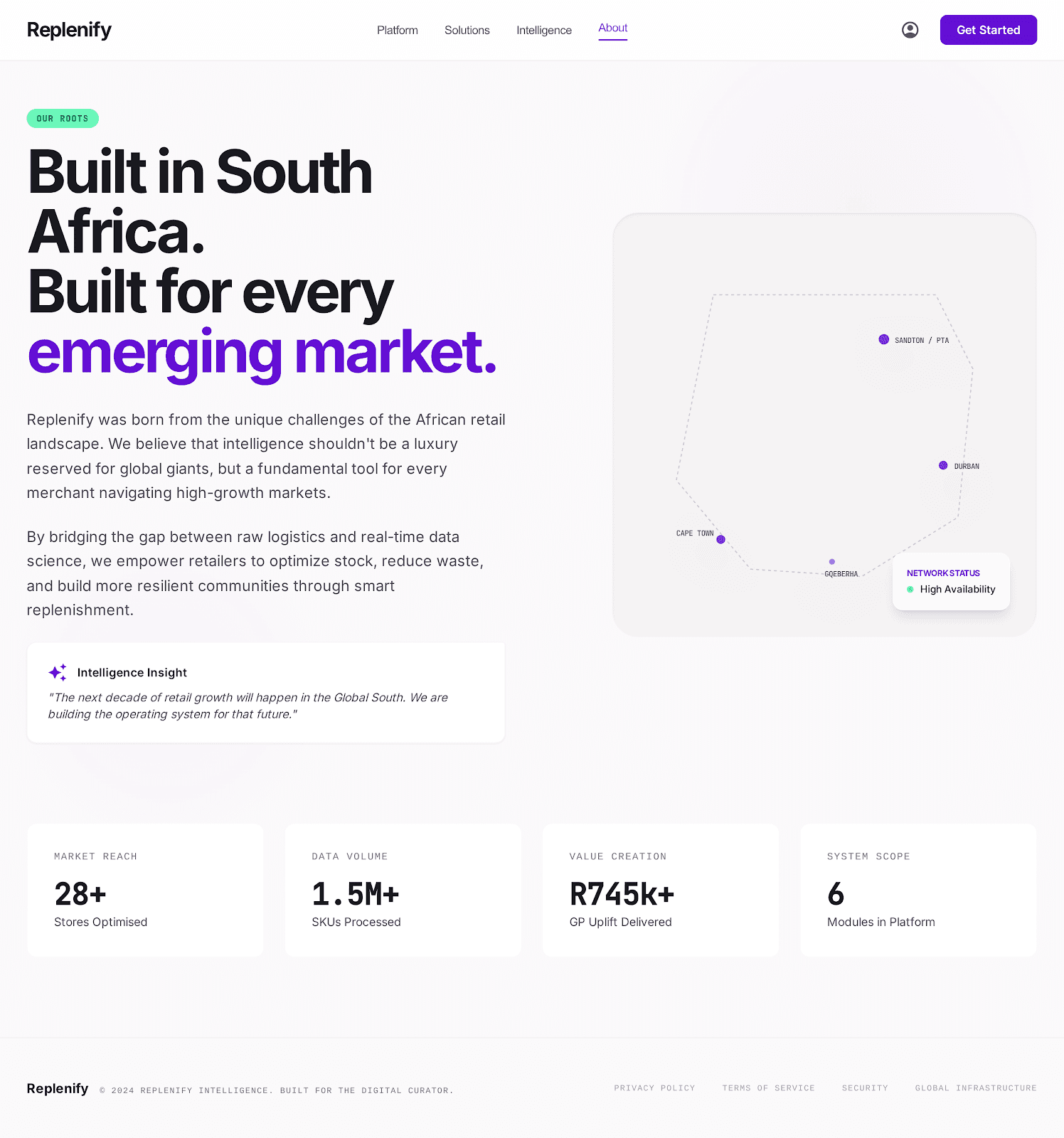
South Africa is not an easy market to optimize inventory for. Import cycles from Asia run 60 to 120 days, which means a buying decision made today carries enormous forecasting risk. The rand moves against you on every overseas order. Logistics across a country the size of France plus Germany means distance is a real cost variable, not a rounding error. Load shedding adds unpredictability that no European demand model accounts for.
We built Replenify here deliberately. If the platform produces reliable GP uplift in South Africa's environment — with all its currency risk, long lead times, and supply chain friction — it will work in any comparable emerging market. The structural challenges in Lagos, Jakarta, and São Paulo are different in detail but similar in shape. SA is the test bed that makes the expansion credible.
The strategy is deliberate: proven in South Africa's demanding environment, now built for retailers worldwide — across Africa, Southeast Asia, and Latin America where mid-market retail faces similar structural challenges.
60-120 daysImport lead times from Asia in demanding markets
Where we're going
Start with rebalancing. Add modules as you need them.
Most retailers start with rebalancing — it has the fastest time-to-value and the clearest GP story. Stock that is in the wrong stores gets moved to the right ones. The result shows up in the next trading week.
From there, the platform grows with the business. Allocation before a new range drops. Replenishment tied to real sell-through. Markdown logic that protects margin instead of destroying it. Each module runs on the same transaction history, so the recommendations improve as the data deepens. More seasons of history means better size curve predictions. More stores means better transfer logic. The value of the platform increases as it learns your business.
6
Modules
Complete merchandise lifecycle
37
Reason codes
Full transparency
265ms
Engine speed
Real-time decisions
R7m
Pilot GP uplift
Verified pilot results